
Wire EDM fluids come in oil-based and water-based types with very different formulations. Manufacturers usually keep their recipes confidential, so it is more useful to judge a product by its composition type than by any marketing claim about a “formula”. The following classification is based on composition.
1. Pure oil type. Made entirely of mineral oil and oil-soluble additives. It is used as supplied and cannot be diluted with water. Typical products include extreme-pressure cutting oil and EDM oil. It cuts efficiently, provides good insulation and arc suppression and prevents rust, but it is polluting, flammable, and cleaning parts requires non-polar chlorinated solvents that are toxic to people — this type has largely disappeared from the market.
2. Emulsion (saponified) type. A mix of mineral oil (at least 60%), emulsifiers and necessary additives; this is the early-generation product. It is diluted with water to a 5% suspension: pour in the soluble oil first, then add ordinary tap water in one go (avoid hard water such as well water), and stir until uniform. Typical products include rust-preventive soluble oil, saponified fluids and water-based paste concentrate. It cuts efficiently and prevents rust well, but it tends to spoil and smell, is hard to observe during cutting, and is not environmentally friendly.
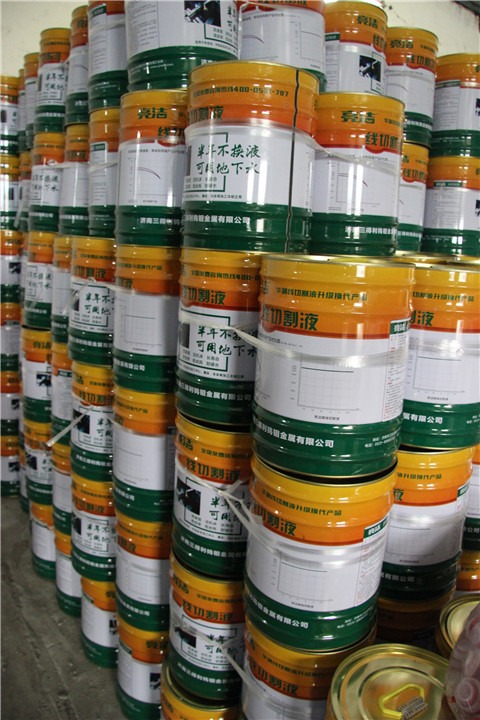
3. Water-based synthetic type. Water-based, formulated with cleaning agents, discharge promoters, rust inhibitors and similar components. It is diluted at a 1:10–20 ratio with water. It contains no mineral oil and no nitrite, is green and pollution-free; quality synthetic products can even be mixed with groundwater and last up to six months. Typical products include synthetic and water-soluble wire EDM fluids and water-based paste concentrates.
4. Water-based products by mineral oil content. Water-based working fluids can be further divided by oil content:
- Emulsion: at least 60% mineral oil, diluted to a 5% suspension.
- Semi-synthetic (micro-emulsion): emulsifiers with about 15–30% mineral oil plus water-soluble rust inhibitors, diluted to a 5–8% suspension.
- Synthetic: entirely water-soluble components, diluted to a 5–25% solution.
All three are mixed with 75–95% water, so water dominates — which is why they are grouped as water-based working fluids. The synthetic type forms a true solution, and the term “water-soluble working fluid” refers specifically to the synthetic type.
5. Selection advice.
- For long service life and environmental performance, prefer a synthetic water-based fluid: no mineral oil or nitrite, longer life and easy cleanup.
- When switching from an emulsion to a water-based product, clean the tank and worktable thoroughly first, so leftover sludge does not impair flushing.
- Match the fluid to the machine — high-speed and medium-speed wire EDM units each have suitable water-based products — and use the recommended mixing ratio.
Summary. Understanding the composition types of wire EDM fluid is the basis for correct selection and mixing. Each type has its own trade-offs among efficiency, environmental performance, life and cost, so choose accordingly.
Need more information? — we reply within 24 hours. Contact our sales team