
Wire EDM machines are widely used across the metalworking industry. Manufacturers rely on them to cut high-strength, high-toughness, high-hardness and brittle materials, as well as magnetic materials and small, intricate or complexly shaped parts. Understanding why the technology spread so far and where it is heading helps buyers choose the right equipment.
1. Why Wire EDM Is Widely Adopted
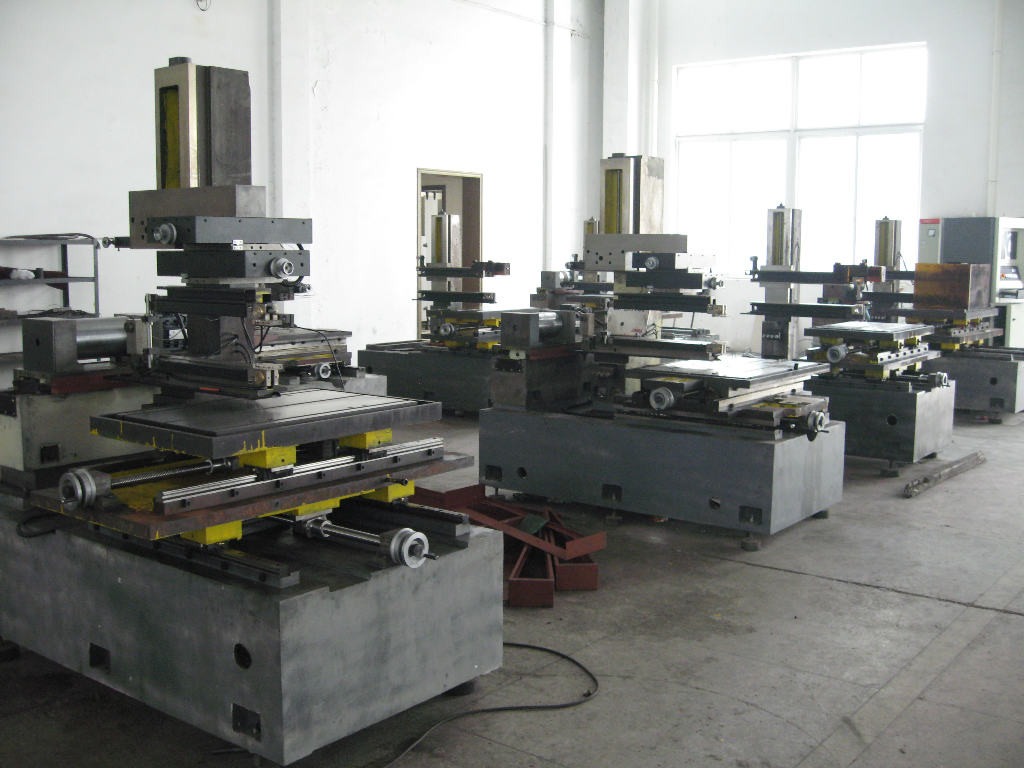
Wire EDM melts metal with the heat of electrical discharges between two conductors. The electrode is a wire that reciprocates vertically — molybdenum wire in HS-WEDM, brass or copper wire in LS-WEDM — while a dielectric fluid flushes, cools and lubricates the cut. A machine combines the body, the CNC system and the high-frequency power supply, providing gap compensation, linear and circular interpolation, and automatic wire-breakage handling. This lets the process cut materials and geometries conventional machining cannot.
Maturity is the main driver of adoption: failure rates have fallen sharply, and the process’s wide applicability makes it a low-risk investment. Smarter CNC systems have broadened its reach further.
2. How NC Systems Became Smarter
- Late 1960s–mid 1970s: transistor gate logic, manual or punched-tape input, glow-tube displays.
- Late 1970s–1980s: medium- and large-scale ICs; fluorescent and LED displays.
- 1980s (single-board era): the Z-80 microprocessor delivered strong functions at low cost, rapidly popularizing CNC wire EDM.
- 1990s (single-chip era): 8051 controllers added backlash compensation, short-circuit retraction, breakage protection, power-failure memory, auto-centering, auto-stop and taper cutting.
- Computer era: one controller runs multiple machines with on-screen monitoring; auto-programming supports commands, drawings, scanning and CAD files.
Looking ahead: next-generation controls will be more stable, practical, simple and convenient — clearly moving toward smarter systems.
3. Market Landscape and Trends
The globalization of HS-WEDM. Wire EDM originated in the mid-20th century. China industrialized high-speed wire EDM first; its simple structure, low cost and low consumable use made it the mainstream choice for die shops in developing markets. Europe, Japan and North America have long favored LS-WEDM for high-precision, high-finish work.
The rise of MS-WEDM. In the early 2000s, medium-speed wire EDM (MS-WEDM) took off: finish quality approaching LS-WEDM, with the simple structure, low cost and low consumption of HS-WEDM. Multi-pass cutting dramatically improves surface quality on high-speed machines, but only machines built to high precision deliver real gains. Priced far below LS-WEDM with quality near entry-level LS-WEDM, MS-WEDM offers a new balance between accuracy and cost.
Consolidation and rational competition. The industry is in an adjustment phase; the destructive price wars of the past are giving way to rational competition. For buyers, that means more time to compare technology roadmaps, service networks and long-term support across suppliers.
Direction of development. Leading manufacturers are pushing toward fast, low-energy, low-cost solutions, with the strongest demand coming from sheet metal and hardware industries. Sustained growth depends above all on technological innovation, supported by alliances, resource sharing and healthy competition.
Summary: From smarter NC systems to the rise of MS-WEDM, the industry is shifting from volume to quality. Understanding the technology’s trajectory helps buyers make wiser decisions in selection and long-term investment.
Need more information? — we reply within 24 hours. Contact our sales team