
Buying a medium-speed wire EDM (MS-WEDM) machine means wading through marketing claims of very uneven quality. Understanding the common traps is the first step toward a machine that genuinely meets your needs.
1. Ten Marketing Pitfalls to Avoid
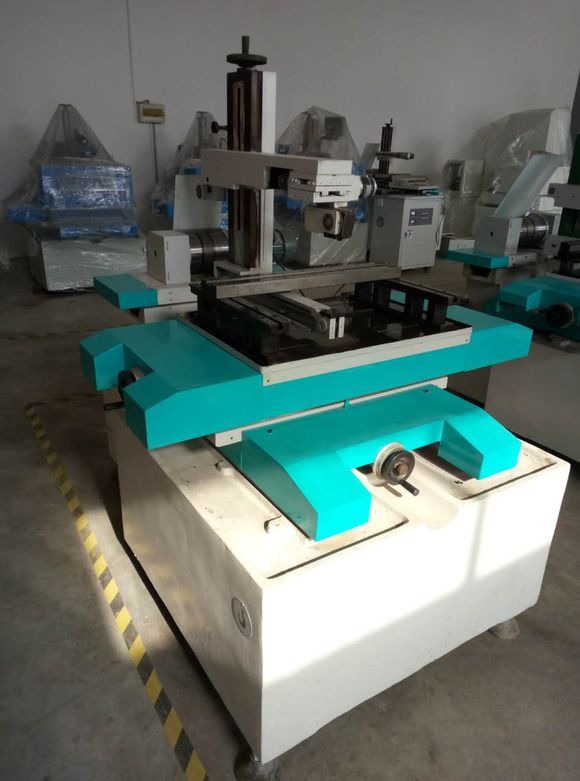
- An HS-WEDM frame sold as MS-WEDM. Retrofitting an HS-WEDM frame with linear guide rails and a finish-capable drive cabinet does not make it MS-WEDM — the two differ fundamentally in mechanics and electricals.
- Maximum speed only, no continuous running. Any efficiency that cannot be sustained for 24+ hours is practically useless; frequent wire changes waste time and cut daily output.
- Best roughness only, no continuous area. A fine Ra is meaningless if the machine cannot cut more than 20,000 mm² continuously. Look for indicators like Ra ≤ 1.0 μm over 30,000 mm.
- No batch consistency. On continuous unattended runs of a dozen or more identical parts (no wire-diameter compensation), consistency should be ≤ 0.005 mm over 30 parts; stepper motors cannot hold micron-level step accuracy.
- Thickness claims only, no longitudinal error. On parts over 100 mm thick, sizes tend to bulge into a “barrel” shape. Longitudinal error should be ≤ 0.01 mm per 100 mm.
- Quality that depends on operator skill. If good results require a skilled operator’s personal technique, the machine is low-end — a good machine reduces that dependence.
- Exaggerated “servo MS-WEDM.” A servo motor speeds up rapid traverse and little else; true servo application needs hundreds of parameters professionally tuned — not a simple motor swap.
- “Full closed-loop” is usually hype. A genuine high-accuracy linear scale costs over 10,000 yuan per axis; a machine priced around 100,000 yuan cannot carry true full closed-loop hardware.
- Linear / maglev motor machines. High-accuracy linear motors cost tens of thousands of yuan per axis plus precision scales, and only million-yuan-class LS-WEDM machines use them.
- Claims of “replacing LS-WEDM.” Like “a Porsche for 100,000 yuan”: MS-WEDM and LS-WEDM occupy different accuracy and cost positions.
Finally, power consumption. At equal performance per price, power use is a long-term cost. A genuinely low-power machine should hit all the indicators above while drawing about 3,500 W on 220 V; a machine that misses the accuracy targets saves no money no matter how little it draws.
2. Acceptance Testing and Comparison Tips
- Compare at the same current: comparing 4 A against 2 A is meaningless; at higher current, accuracy drops and 0.01–0.02 mm makes a real difference.
- Cabinet quality: good-brand cabinets produce finer spark gaps, better finish and higher accuracy; off-brand cabinets can lose around 0.01 mm.
- Factory settings may be off: stay in contact with the manufacturer, feed back results and ask for solutions.
- Set expectations: MS-WEDM is generally HS-WEDM accuracy plus finish-cut improvement. If a new machine is no better than the old one, find out why — do not accept delivery until the responsibility is clear.
3. New-Machine Setup Steps
- Fit the leveling feet; rough-level the bed.
- Remove all shipping brackets and support blocks.
- Tighten the X/Y lead screw nuts evenly onto the right-angle brackets.
- Install sheet metal and guards.
- Clean rust-prevention oil from the table, fixtures and spool area.
- Lubricate the lead screws, guide rails and moving parts.
- Fine-level the machine: within 0.04 mm over 1000 mm.
- Check the cabinet for loose connections.
- Connect the machine to the cabinet and the cooling system.
- Verify motor phases, dielectric flow, spark discharge and switch functions.
- Cut a test workpiece.
Summary: judge an MS-WEDM purchase on four hard indicators — continuous running, batch consistency, longitudinal error and power consumption — and treat flashy concepts with skepticism. Work through the eleven setup steps and stay in contact with the manufacturer.
Need more information? — we reply within 24 hours. Contact our sales team