
Troubleshooting wire EDM electrical faults is far faster with a methodical approach. This article summarizes four analysis methods and two common fault families.
1. Four Circuit Fault Analysis Methods
Divide and conquer
Split the schematic into main and control circuits. The main circuit covers the spool and pump motors; the control circuit covers triggering, adjustment, drive and control boards. Judge which part a symptom belongs to and narrow down the search.
Reverse reasoning
With a fault localized, assume a specific open or short and simulate the theoretical result, comparing it with observed behavior to confirm the cause.
Circuit simulation
For major faults, an oscilloscope checks output signals at critical stages. When simple measurements are inconclusive, simulation software confirms a faulty component faster.
Spare-part substitution
Repair staff often lack a full schematic. For major faults, swap in spare PCBs and commonly replaced parts to restore operation quickly.
2. Repeatedly Blown Fuses
Repeated fuse blowing usually means an electrical short or breakdown. Check these five items:
- Is the brake capacitor broken down?
- Is the rectifier bridge broken down?
- Is the spool motor shorted or running single-phase?
- Is the reversal board faulty?
- Is a contactor broken down internally?
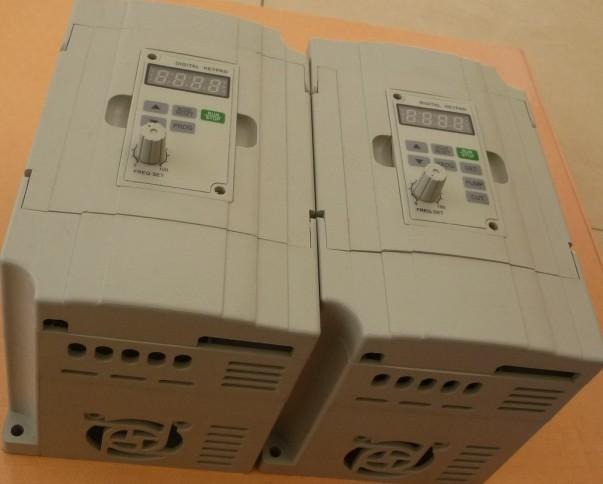
3. Common Variable-Frequency Drive Faults
Load short circuit — caused by phase-to-phase shorting in motor wiring or a damaged inverter module. Check the motor windings and insulation; contact the manufacturer if needed.
Heatsink overheating — caused by high ambient temperature, a failed fan or blocked airflow. Lower the temperature, replace the fan, clear the duct.
Motor overload — caused by low line voltage, wrong rated-current setting, an unsuitable V/F curve, a standard motor running long at low speed under load, stall or sudden load change, or an undersized motor. Check the supply and settings, adjust the V/F curve and torque boost, use an inverter-duty motor, and review the load.
Drive overload — caused by low line voltage, excessive load, too-short acceleration, or restarting a spinning motor. Check the supply, use a larger drive, lengthen acceleration, avoid restarting a rotating motor.
Serial communication fault — caused by wrong baud rate/parity settings or prolonged interruption. Check parameters and wiring.
External fault — an external fault input was triggered. Check the external device.
Input phase loss — check the R, S, T inputs. Output phase loss or imbalance — check the U, V, W motor wiring and the load.
EEPROM fault — restore factory defaults; contact the manufacturer if it persists.
Keypad/control board communication loss — replace the connection cable.
Brake unit fault (bCE) — caused by a damaged brake circuit/transistor or an undersized brake resistor. Check the brake unit, replace the transistor, fit the correct resistor.
Parameter copy error (PCE) — caused by interference on the copying cable or mismatched parameters. Shorten the cable and confirm parameters match the drive type.
Summary: Circuit faults are best handled by narrowing the scope, supported by reverse reasoning, simulation and part substitution. Blown fuses point to breakdowns; drive faults map to codes — most problems are quickly isolated.
Need more information? — we reply within 24 hours. Contact our sales team